


Accession by NAJ of the historical public records and archives, from various ministries and agencies, is carried out in accordance with the Public Archives and Records Management Act (Act No. 66 of 2009).
Historical public records and archives in the possession of state administrative organs and Incorporated Administrative Agencies are transferred to NAJ upon expiration of their retention periods. When a state administrative organ intends to dispose administrative documents whose retention periods have expired, it must obtain the consent of the Prime Minster in advance. This procedure ensures reliable transfer of historical public records and archives.
In practice, prior to the transfer of materials, NAJ confers with the administrative organ on matters such as the date of transfer.

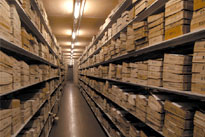
In order to prevent damages caused by mold, insects, etc., the Specified Historical Public Records and Archives newly brought into the National Archives from ministries and agencies are fumigated before shelving.
An ethylene oxide fumigation machine (reduced-pressure type) is used and it takes approximately ten days to complete a fumigation treatment.


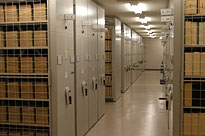
The Specified Historical Public Records and Archives for which fumigation treatments and arrangement have been completed are stored in the stack area where the temperature is maintained at 22 degrees Celsius and the humidity at 55% so that they can be protected against direct sunlight, high temperatures and humidity, dust, atmospheric pollutants, etc.
In the stack area, smoke detectors and carbon dioxide and Inergen gas fire extinguishing systems are installed for fire protection.

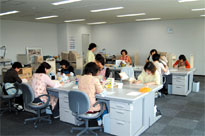
Catalogs of files (Bosatsu Mokuroku, i.e. catalogs of bound volumes of records and archives) and, in the case of need, detailed catalogs of each item in a file (Kenmei Mokuroku) are created for newly accessioned Specified Historical Public Records and Archives. Catalog data is provided through a Digital Archive System enabling users to search these catalogs on the Internet.

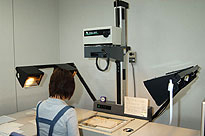
National Archives conducts media conversion of the Specified Historical Public Records and Archives transferred in the paper form, considering their level of deterioration and frequency of use. Materials which show rapid deterioration are converted into microfilm while frequently used ones with a better preservation status are digitized directly.

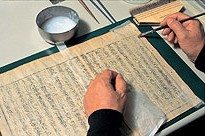
Of the materials held by the National Archives, many are subject to deterioration over time, and some of them have been damaged by insects, mice, water, smoke, acidification, etc., and may thus be inaccessible to users.
Professional restorers determine the extent of damage and repair the affected parts, by applying various restoration methods, including paper patching, complete backing, interleaving, and leaf casting.
3-2 Kitanomaru Koen, Chiyoda-ku, Tokyo 102-0091
TEL:+81-3-3214-0641